June 25, 2026 · 9 min read · By Tim
Money on Koh Samui: Cash, ATMs, Cards & Tipping
Money on Koh Samui is simple once you understand a handful of local quirks. Cards work in more places than first-time visitors expect; cash is still essential for the parts of the island that make a trip memorable. The mistakes we see most often are small and avoidable: exchanging at the airport, paying repeated ATM fees, or arriving without a sense of what to tip the villa team.
This guide covers the practical mechanics — currency, ATMs, cards, exchange and tipping — for guests staying in private villas. For the broader budget picture, see our Koh Samui cost breakdown.
The Thai baht in one paragraph
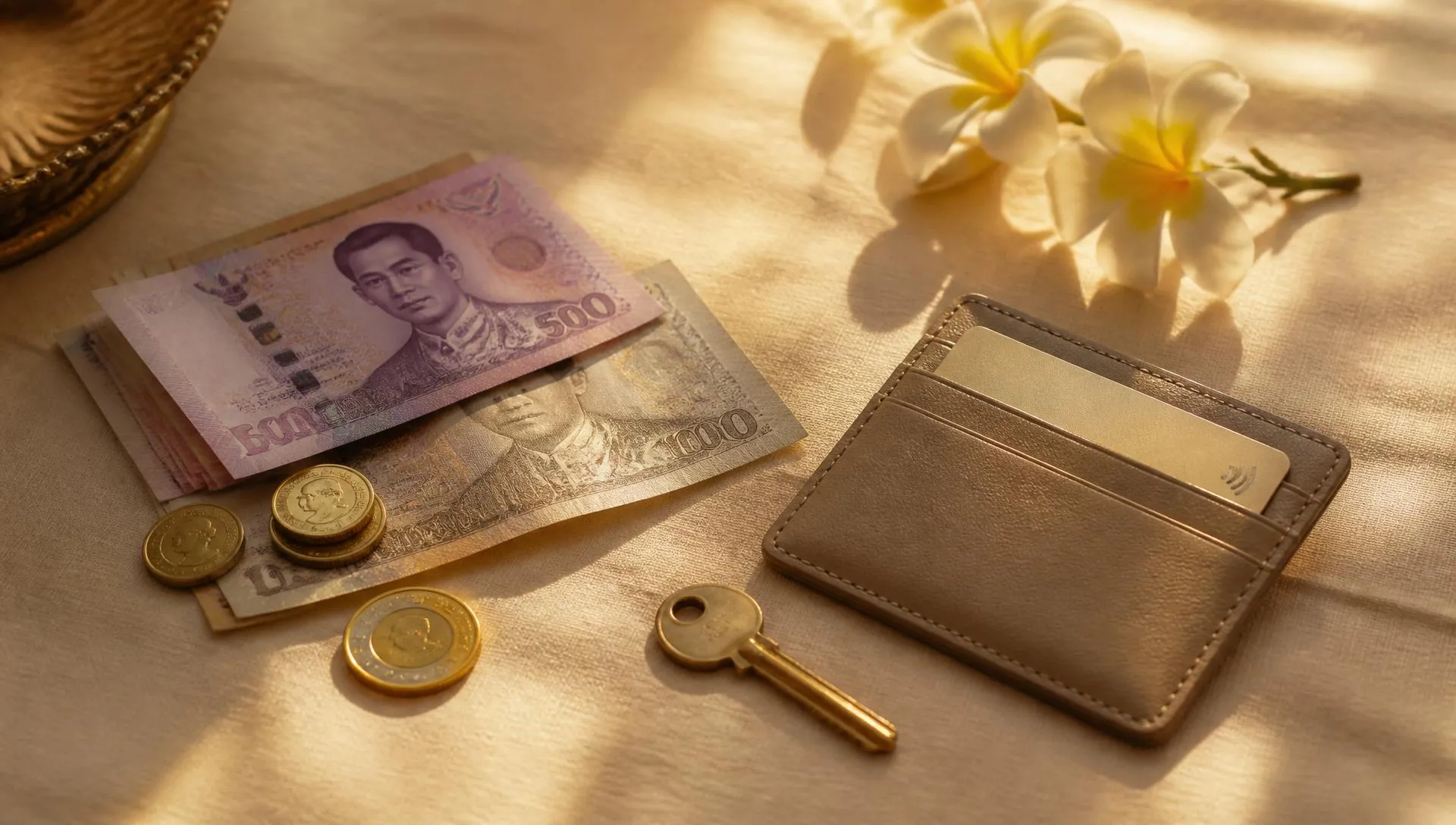
The Thai baht (฿, THB) is the only currency accepted on Koh Samui. Notes come in 20 (green), 50 (blue), 100 (red), 500 (purple) and 1,000 (grey). Coins run from 1 to 10 baht. The 1,000-baht note is the workhorse for villa life — ATM machines dispense them, restaurants and supermarkets break them without comment — but you'll want a stash of 100s and 20s for taxis, tips and street food, where change for a 1,000 is often a polite problem.
Indicative rates fluctuate, but as a working anchor: roughly 38 THB to 1 EUR, 35 THB to 1 USD, 44 THB to 1 GBP. Check live rates at Bank of Thailand before you travel.
ATMs — how they really cost you
Every ATM on Koh Samui charges foreign cards a flat 220 THB per withdrawal. This fee is fixed by Thai regulation and applies whether you withdraw 1,000 or 20,000 THB. Your home bank may add its own foreign-transaction fee on top — typically 1–3%.
Two practical rules follow:
- Withdraw larger amounts less often. One 20,000 THB withdrawal costs the same 220 THB fee as four 5,000 THB ones.
- Use a card with no foreign-transaction fee if you have one. In Europe, Revolut, Wise and N26; in the US, Charles Schwab and Fidelity are common choices.
Most Thai ATMs cap a single withdrawal at 20,000–30,000 THB. Bangkok Bank and Krungsri ATMs tend to allow the higher end. ATMs are everywhere — Tesco Lotus, 7-Eleven forecourts, every shopping plaza in Chaweng, Bophut, Lamai and Maenam.
Cards — where they work and where they don't
Visa and Mastercard are accepted across most of the places a villa guest spends meaningful money: better restaurants, beach clubs, supermarkets (Tesco Lotus, Tops, Makro, Villa Market), boutique shops in Fisherman's Village, spa resorts, and reputable car-rental agencies. American Express works at the upper end — Four Seasons, Six Senses, some fine-dining restaurants — but is far from universal.
Cash-only territory includes:
- Songthaew (red truck) shared taxis and many private drivers
- Local markets, including Maenam Walking Street and the Bophut Friday night market
- Small Thai restaurants, street food, beachside seafood grills
- Muay Thai gyms, yoga drop-ins, most independent massage shops
- Temple donations and small island activities
A 3% surcharge is occasionally added to card payments. It's usually disclosed but not always — ask before signing. Contactless payments work wherever cards are accepted; mobile wallets (Apple Pay, Google Pay) are increasingly common at modern venues.
Currency exchange — where the rates are honest
Exchange rates inside Thailand are almost always better than at your home airport. On the island, licensed booths such as SuperRich (Chaweng, Bophut), Vasu Exchange and bank-branch counters offer rates within a fraction of a percent of the interbank mid-rate. The Samui airport exchange desk is convenient but noticeably worse — change only what you need for the first taxi.
Three practical notes:
- Bring crisp, unmarked banknotes. Torn, written-on or heavily creased foreign bills are routinely refused.
- The larger the denomination, the better the rate. 100 EUR or 100 USD notes typically receive a better rate than 20s.
- Avoid hotel front-desk exchange unless the amount is trivial — rates can be 3–5% worse.
For long stays, no Thai bank account is necessary. Multi-currency cards (Wise, Revolut) cover everyday spend and large withdrawals at minimum cost.
Tipping — what's actually customary
Tipping in Thailand is appreciated but never expected. Refined practice — rather than aggressive over-tipping — is what locals notice and remember. As a rough framework for villa guests:
- Restaurants — round up or add 10% if no service charge is already included; many higher-end restaurants add 10% service automatically.
- Private driver — 100–200 THB per day; more for a long airport transfer or a full-day island tour.
- Spa therapist — 100–300 THB per treatment, handed directly to the therapist.
- Hotel porter — 50–100 THB.
- Boat crew (full-day charter) — 500–1,000 THB per guest, split among the crew.
- Villa staff at end of stay — roughly 5–10% of the total villa rate, distributed across the team (housekeeper, gardener, pool attendant, chef if applicable). Your villa manager will advise on the right total and prepare envelopes.
The villa-staff tip is the one most guests ask us about. There is no fixed rule, but 5–10% of the nightly villa rate over the length of stay is a sensible anchor, weighted toward the housekeeper and any chef who cooked for you. For groups planning a longer celebration or retreat, we usually agree the structure in advance so it's never awkward at checkout.
A simple money plan for a one-week stay
For a couple or small family staying in a private villa for a week, a realistic working plan looks like this:
- 5,000 THB in cash on arrival — covers airport transfer tip, first-day taxis, water at the 7-Eleven.
- One ATM withdrawal of 20,000–30,000 THB in the first 48 hours — covers a week of taxis, street food, markets, beach bars and small-spend extras.
- Cards for everything else — restaurants, supermarket shop, spa, beach clubs, fuel for a rented car or scooter.
- A separate small envelope of 100- and 500-baht notes set aside for tipping.
If you're planning a longer or larger trip — a family of eight, a bachelorette weekend, a wedding — we'll talk through cash needs as part of pre-arrival planning. Yacht charters, private chefs and full-day photographers all have their own cash conventions.
How We Do It
Every villa in our collection is inspected personally and managed by a local team we work with year-round. When you book directly, your villa manager handles the small money questions that no online guide can answer for your specific stay — current ATM locations near your villa, an honest exchange booth within driving distance, how to settle the chef's grocery shop, and the right end-of-stay envelopes for the staff who looked after you.
If you would like a shortlist of villas and a tailored pre-arrival note covering cash, cards and tipping, send a message — a real person on the island will reply within a working day.
Frequently Asked Questions
The Thai baht (THB) is the only accepted currency. You don't need to bring large amounts from home — exchange rates inside Thailand are almost always better than at European or North American airports. Bring a small float in your home currency for emergencies and the airport, then withdraw or exchange baht once you arrive.
Every Thai ATM charges foreign cards a flat fee of 220 THB per withdrawal, on top of whatever your home bank adds. The fee is the same for 1,000 THB or 20,000 THB, so withdraw larger amounts less often. Maximum per withdrawal is typically 20,000–30,000 THB depending on the bank.
Visa and Mastercard are accepted at most restaurants, hotels, supermarkets and reputable shops. American Express works at higher-end venues but is far from universal. Songthaew taxis, local markets, small cafés, Muay Thai gyms and most street food stalls are cash-only. A 3% card surcharge is sometimes added — ask before paying.
Tipping is appreciated but never obligatory. Restaurants: round up or 10% if no service charge is included. Drivers: 100–200 THB per day for a private driver. Spa therapists: 100–300 THB per treatment. Villa staff at the end of a stay: roughly 5–10% of the total villa rate, distributed across the team — your villa manager can advise on local custom and prepare envelopes.
SuperRich and licensed exchange booths in Chaweng, Bophut and Lamai consistently offer the best rates — better than banks and far better than the airport. Bring crisp, unmarked notes; torn or stained foreign bills are often refused. Avoid exchanging at your hotel front desk unless the amount is small.
Koh Samui is a low-crime destination by international standards, and carrying a few thousand baht in a card wallet is completely normal. For larger sums, use the in-villa safe. Pickpocketing is rare but possible in crowded night markets — split cash between a wallet and a second pocket if you're carrying more than 10,000 THB.