May 6, 2026 · 8 min read · By Tim
The Thai Kitchen: Chillies, Pad Kra Pao & Cooking on Koh Samui
Thai food is one of the easiest cuisines in the world to enjoy badly, and one of the most rewarding to enjoy properly. The version most visitors first meet — sweet pad thai, mild green curry, a Singha beer on the side — is real, but it's a curated, export-friendly slice of a much larger and sharper kitchen. Spend a little time on Koh Samui and the rest comes into focus quickly: the heat of a fresh bird's eye chilli, the salt of fish sauce, the funk of fermented shrimp, the way a single basil leaf changes a whole dish.
This is a short, personal take on the Thai kitchen as I've come to know it living on the island — what makes it work, the dish I order more than any other, the role chillies actually play, and where you can cook alongside our villa teams if you want to take some of it home with you.
What Makes the Thai Kitchen Tick
The Thai kitchen runs on a very small set of building blocks, used with extraordinary discipline. Almost every savoury dish you'll eat on Koh Samui balances four flavours at once: salty (fish sauce, soy, shrimp paste), sour (lime, tamarind, vinegar), sweet (palm sugar, coconut), and spicy (chillies, white pepper). A good cook adjusts these in real time, tasting and rebalancing as they go — which is why the same dish at two different stalls can taste like two different recipes and both be excellent.
The aromatics are similarly tight: garlic, shallots, lemongrass, galangal, kaffir lime leaves, coriander root, holy basil, and Thai sweet basil. Coconut milk anchors the southern curries. Jasmine rice or sticky rice carries everything. There's very little dairy, very little wheat, and almost no oven work — the wok, the mortar and pestle, the charcoal grill, and the steamer do the vast majority of the cooking.
It's a kitchen built for heat, humidity, and speed. Most dishes come together in minutes from ingredients bought that morning, which is one reason markets remain central to daily life — including the Friday Walking Street in Bophut and the everyday food markets in Lamai and Maenam.
Thai Chillies: Small, Fresh, Serious
If there is one ingredient that defines the difference between Thai food at home and Thai food in Thailand, it's the chilli. The everyday workhorse is prik kee noo — the bird's eye chilli — a tiny red or green pepper that delivers a clean, fast heat without much background flavour. It's used fresh, not dried, and almost always added late so the heat stays sharp.
You'll meet it in three main places:
- Inside the dish itself — pounded into curry pastes, sliced into stir-fries like pad kra pao, or scattered across a salad.
- In the condiment caddy — the four small jars on every Thai table contain fish sauce with sliced chillies (prik nam pla), chilli flakes, sugar, and vinegar with chillies. You season as you go.
- In dipping sauces — nam jim seafood for fish, nam jim jaew for grilled meat, prik nam som for noodles.
The trick is that heat in Thai cooking is rarely the point. It's a frame around the other flavours: it lifts the salt, sharpens the sour, and makes the sweet feel cleaner. Order a dish mai phet (no chilli) and it doesn't just become milder — it often becomes flat. If you're new to the heat, ask for phet nit noi ("a little spicy") and work up from there.
Pad Kra Pao: My Default Order
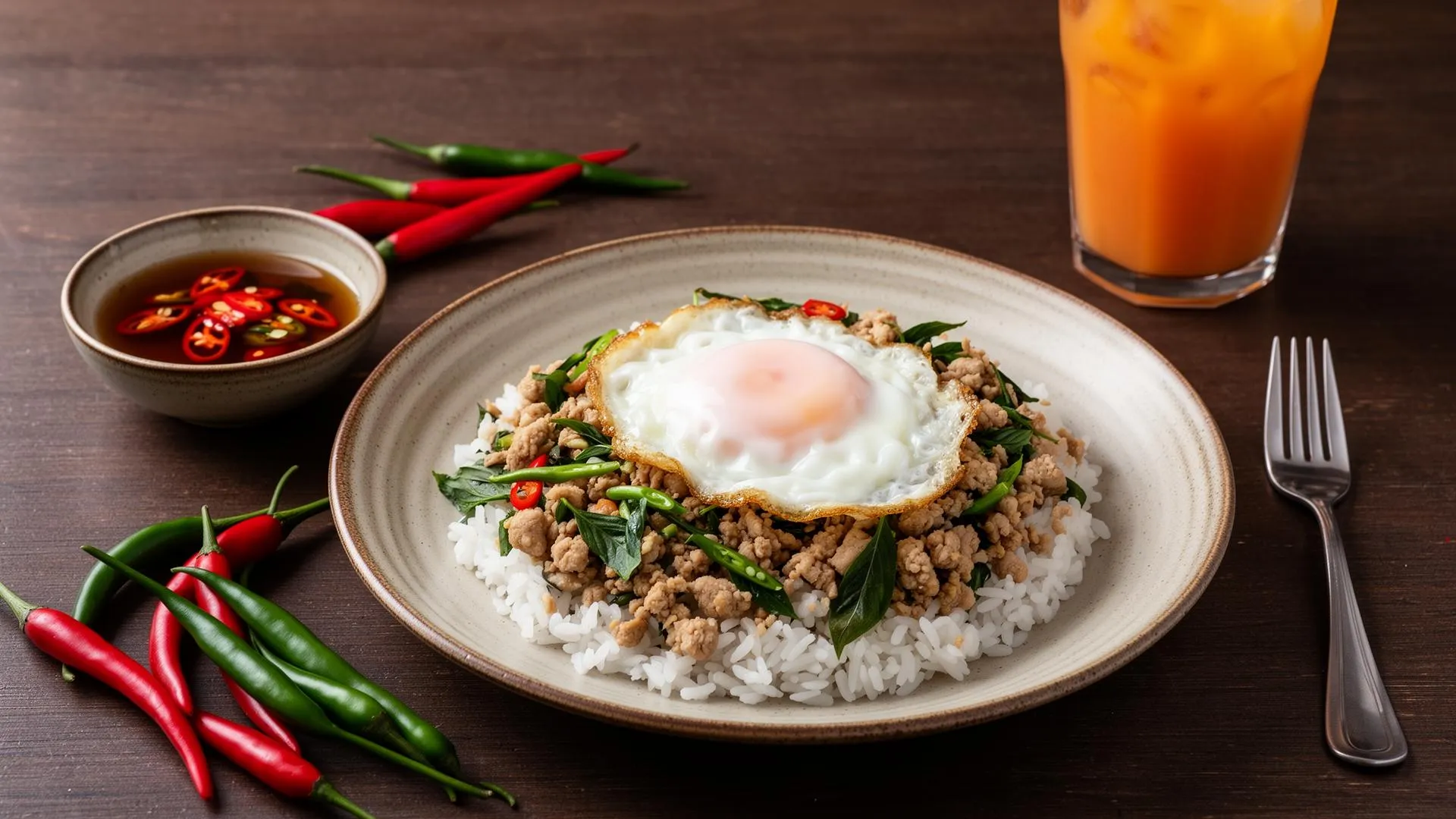
If I had to pick one dish that captures everyday Thai food on Koh Samui, it's pad kra pao — and specifically pad kra pao gai kai dao: minced chicken stir-fried with holy basil and chillies, served over jasmine rice with a crispy fried egg on top.
It's the dish I order more than any other. Every food court has it, every street stall makes it, every villa cook knows it by heart, and almost no one makes it badly. The pleasure is in the contrasts: the salty-sweet stir-fry, the peppery heat of holy basil (kra pao, not the sweeter horapha basil used in green curry), the soft yielding rice, and the egg with its crisp lacy edges and runny yolk that you break over the whole plate.
How I order it:
- Gai sap (minced chicken) over moo sap (minced pork), though both are classic.
- Phet (proper spicy) — the heat is the dish.
- Kai dao (fried egg) on top, yolk soft.
- A small side of prik nam pla (fish sauce with sliced chillies) to season at the table.
Cost on Koh Samui: usually 60–100 baht at a local stall, up to 250 baht in a Western-leaning café. The cheaper version, made over a roaring wok by someone who's cooked it a thousand times, is almost always the better one.
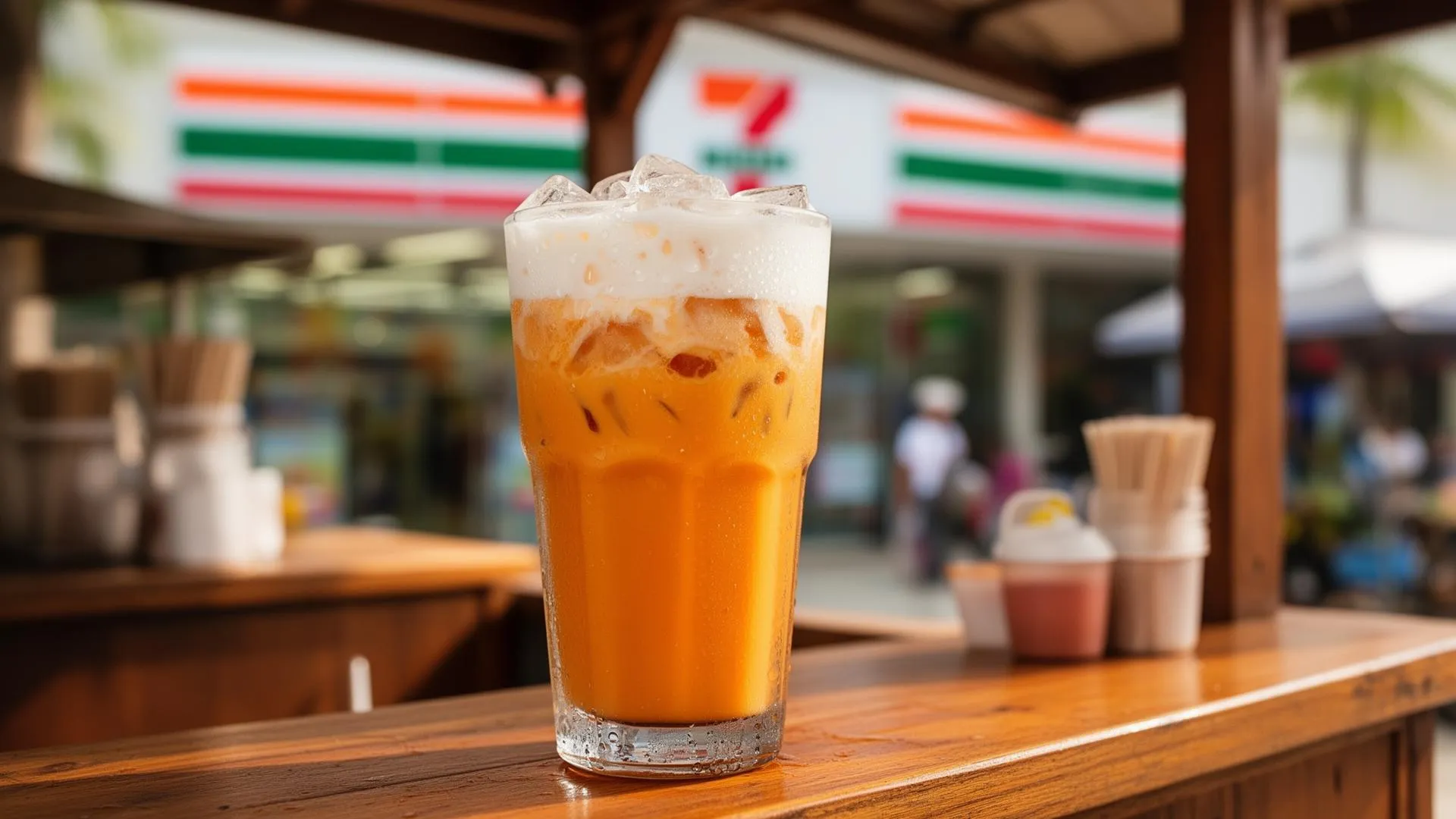
The natural pairing — and the way most Thai people drink alongside spicy lunch food — is a tall glass of cold Thai iced tea (cha yen). The sweetness and creamy finish do something water and beer can't: they actually neutralise the capsaicin instead of just rinsing it around your mouth. It's a small trick, but once you start ordering them together you don't really stop.
Typical Dishes on Koh Samui
Koh Samui sits in southern Thailand, and the local kitchen reflects that: more seafood, more coconut, a strong Muslim-Thai influence in dishes like massaman and khao mok gai, and a particular love for sour-spicy curries built around fish.
A short list of dishes I'd specifically order on the island, beyond the obvious pad thai and green curry:
- Massaman curry (gaeng massaman) — slow-cooked, mildly spiced, fragrant with cinnamon, cardamom, and roasted peanuts. Usually beef or chicken. The most "European-friendly" Thai curry without being a compromise.
- Gaeng som pla — a sharp, sour orange curry built around fresh fish and vegetables. Aggressively tangy, low in coconut, very southern.
- Khao mok gai — Thai-Muslim chicken biryani, turmeric-yellow rice with stewed chicken, fried shallots, and a sweet-sour dipping sauce. A Koh Samui staple, especially around Maenam.
- Pla pao — whole fish (often sea bass) stuffed with lemongrass, salt-crusted, and grilled over charcoal. Served with nam jim seafood, sticky rice, and raw vegetables. The headline dish at most beachfront seafood spots.
- Som tam — green papaya salad pounded to order in a wooden mortar. Som tam thai is the gateway version; som tam pu pla ra with fermented crab and fish is the deep end.
- Hoi tod — a crisp oyster or mussel pancake fried on a flat griddle, served with sweet chilli sauce. Perfect at a night market.
- Khanom jeen nam ya — fresh rice noodles served cold with a hot fish curry poured over the top, plus a tray of raw vegetables and herbs. A Sunday-morning institution.
Most of these are easier to find at proper Thai restaurants and markets than at hotel buffets — another reason a villa with a kitchen and a cook is such a different way to experience the island.
Cooking with the Villa Team
Several villas in our collection can arrange a private cooking session with the on-site cook, or a more structured Thai cooking class as part of your stay. The format varies by property, but the most common shape is:
- An early-morning market visit — usually the local food market in Lamai, Bophut, or Maenam — to pick fresh herbs, vegetables, seafood, and coconut.
- A hands-on session in the villa kitchen preparing three to four classics: typically a curry paste from scratch, a stir-fry like pad kra pao or pad thai, a soup such as tom kha gai, and a salad like som tam.
- A shared lunch or dinner of everything you've made, usually around the villa's outdoor dining table.
It's one of the experiences guests consistently remember most from their stay — partly because of what you learn (curry paste from a mortar and pestle is a revelation), and partly because of the time spent with the team. Several of our cooks have been with their villas for years and treat the class less as a service and more as something they actually enjoy.
If a structured class isn't quite the right format, an alternative is a private chef stay, where the cook quietly turns the kitchen into the centre of the holiday without you having to lift a knife. Both work; they're just different ways into the same kitchen.
Recipe Card: Pad Kra Pao Gai
A villa-kitchen version of the dish, scaled for two and written the way our cooks actually make it. Total time: about 15 minutes once everything is on the bench. Serves 2.
Ingredients
- 300 g minced chicken (gai sap) — thigh meat preferred over breast
- 4 cloves garlic, peeled
- 4–8 fresh bird's eye chillies (prik kee noo), to taste
- 1 large handful holy basil leaves (bai kra pao) — Thai sweet basil works at a pinch but isn't the same
- 2 tbsp neutral oil (rice bran or sunflower)
- 1 tbsp oyster sauce
- 1 tbsp light soy sauce
- 1 tsp dark soy sauce (for colour)
- 1 tbsp fish sauce (nam pla)
- 1 tsp palm sugar (or brown sugar)
- 2 tbsp water or chicken stock
- 2 portions jasmine rice, freshly steamed
- 2 eggs plus extra oil, for the fried egg (kai dao)
- Prik nam pla, to serve: 2 tbsp fish sauce with 2 sliced bird's eye chillies and a squeeze of lime
Method
- Pound the aromatics. In a mortar and pestle, pound the garlic and chillies into a coarse paste. No mortar? Chop both very finely with a knife — do not use a blender, the texture matters.
- Fry the egg first. Heat 3 tbsp oil in a small wok or pan over high heat until shimmering. Crack in an egg and let it bubble and crisp at the edges, basting the white with hot oil until the lace turns golden and the yolk is still soft. Lift out, drain, repeat. Set aside.
- Start the stir-fry. Wipe out the wok, add 2 tbsp fresh oil, and place over high heat. Add the garlic-chilli paste and stir for 10–15 seconds until fragrant — do not let it brown.
- Add the chicken. Tip in the minced chicken and stir-fry hard, breaking it up, until it loses its raw colour (about 2 minutes).
- Season. Add the oyster sauce, light soy, dark soy, fish sauce, and palm sugar. Splash in the water or stock to keep the pan loose. Stir-fry another 1–2 minutes until the sauce clings to the meat.
- Finish with basil. Kill the heat, throw in the holy basil, and toss two or three times — just enough for the leaves to wilt and release their pepperiness. Taste and adjust with a few more drops of fish sauce if it needs salt.
- Plate. Mound jasmine rice on one side of the plate, spoon the stir-fry alongside, and lay the crispy fried egg on top. Serve immediately with a small dish of prik nam pla on the side.
Cook's notes
- The basil goes in last and barely cooks — anything more than 10 seconds in the pan and it loses its character.
- For pad kra pao moo, swap the chicken for minced pork. For a vegetarian version, use crumbled firm tofu and replace the fish sauce and oyster sauce with light soy and a splash of mushroom sauce.
- Serve with a tall glass of Thai iced tea (cha yen) — the proper pairing.
Use your browser's print function (⌘/Ctrl + P) to save this recipe as a one-page PDF.
A Few Practical Notes
- Heat tolerance builds quickly. After a week on the island, the same phet nit noi you ordered on day one will start to feel mild.
- Allergies and dietary needs travel well in Thai kitchens. Vegetarian (jay or mangsawirat), nut-free, and shellfish-free versions of most dishes are easy to arrange — particularly with a villa cook, who can simply adjust the recipe.
- Tap water isn't drinkable, but ice in restaurants is industrially produced and safe; the cylindrical ice with a hole through the middle is the giveaway.
- Tipping the cook isn't expected but is genuinely appreciated, especially after a hands-on cooking session.
Thai food rewards curiosity. Order the dish you can't pronounce, ask the cook what they'd actually eat for lunch, sit down at the plastic-stool stall instead of the air-conditioned restaurant. The kitchen is generous in a way that's hard to describe until you've spent some time inside it — and a stay on Koh Samui is one of the easier ways to do exactly that. For more local favourites in the same spirit, see Tim's Koh Samui recommendations.
Frequently Asked Questions
Pad kra pao (ผัดกะเพรา) is a stir-fry of minced meat — usually chicken (gai), pork (moo), or beef — with holy basil, garlic, bird's eye chillies, fish sauce, oyster sauce, and a touch of sugar. It's served over jasmine rice and almost always topped with a crispy fried egg (kai dao). It's the everyday workhorse of Thai cuisine: fast, cheap, intensely flavoured, and available at virtually every street stall and food court on Koh Samui.
It can be very spicy. The small bird's eye chilli (prik kee noo) drives most of the heat in classics like pad kra pao, tom yum, and som tam. As a foreigner you can ask for 'mai phet' (not spicy) or 'phet nit noi' (a little spicy). At villas with private chefs, the team will calibrate heat to your preference — including bringing the chillies back gradually as you adjust.
Yes. Several villas in our collection can arrange a private cooking session with the on-site cook or a dedicated Thai cooking class — typically a market visit followed by hands-on preparation of three to four dishes such as pad thai, green curry, tom kha gai, and som tam. There are also independent cooking schools in Bophut and Lamai for guests who prefer a group setting.
Beyond pad kra pao, the dishes most associated with the south and Koh Samui specifically are massaman curry, gaeng som (sour orange curry, often with seafood), khao mok gai (Thai-style biryani with a strong Muslim-Thai influence), grilled whole fish (pla pao) with nam jim seafood, and fresh papaya salad (som tam). Coconut, lemongrass, and fresh seafood dominate the local style.
Cold drinks help, but sugar helps more than ice. A traditional pairing is Thai iced tea (cha yen) — its sweetness and creamy finish neutralise capsaicin far better than water or beer. See our [Thai tea and ChaTraMue guide](/journal/guides/thai-tea-chatramue-guide) for how I order mine.